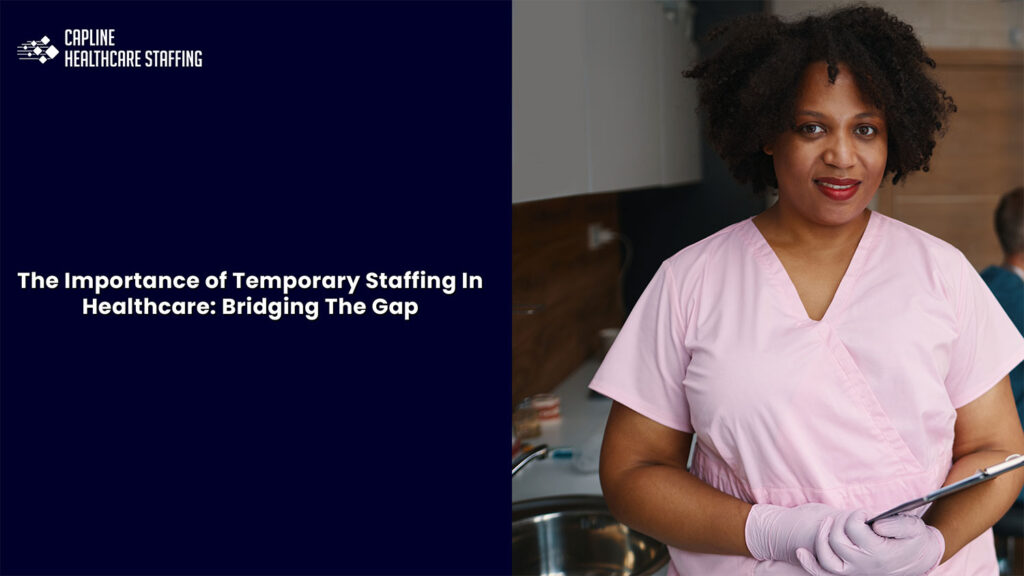
Healthcare facilities struggle to maintain sufficient staffing ratios while protecting patient care standards. National medical facilities now use temporary healthcare staffing as an essential solution to overcome their staff shortage problems. Healthcare facilities across the board now use adaptable staffing models that help them respond to variable patient requirements and preserve their ongoing operations.
The healthcare staffing crisis has intensified in recent times and medical facilities now struggle to recruit necessary professional roles. The staffing shortage creates problems throughout healthcare facilities including both large metropolitan centers and smaller rural areas with restricted healthcare availability. Inadequate staffing creates direct consequences that damage both patient safety as well as their treatment results.
Through an extensive discussion, we will study the role of short-term medical staffing solutions in filling strategic medical workforce vacancies. This section will evaluate the advantages alongside obstacles of this practice together with guidelines for healthcare facilities to execute effective temporary staffing methods.
A staffing shortage threatens the delivery of reliable high-quality healthcare throughout medical facilities throughout the United States. Labor Statistics Bureau predicts healthcare facilities must create 2.6 million new positions by 2030 because nursing roles represent the majority of this employment need.
Healthcare worker burnout has skyrocketed in recent times and that has caused both an uptick in career changes and medical staff exiting early from their roles. The mass departure of veteran medical staff has created an extensive number of job vacancies that standard recruiting procedures need significant time to properly fill. The resulting staffing shortages result in substandard care delivery combined with heavier workloads for currently employed staff.
Healthcare facilities face intensified staffing challenges due to seasonal changes in patient delivery which happen during flu outbreaks and times of public health crises. Healthcare organizations need fast workforce scaling to meet periodic demand surges but standard hiring methods are insufficient to handle this requirement.
Strategic workforce planning methods now incorporate temporary healthcare staffing services after their initial development as a crisis management solution. The present-day medical staffing industry operates through enhanced systems that successfully pair physicians and healthcare providers with vacant positions at clinics on an hours-to-day basis rather than weeks.
Temporary staffing as a practice has advanced beyond its original nursing applications to cover the placement of physicians alongside allied health professionals and administrative staff. The expanded strategy enables healthcare facilities to fill staffing needs throughout all departments while maintaining higher precision and flexibility.
The combination of digital tools along with cutting-edge matching programs has fundamentally improved the staffing procedure through enhanced efficiency and immediate crisis reaction. Modern technology allows healthcare facilities to execute rapid professional identification and effective recruitment of required candidates.
Healthcare facilities can obtain urgently needed qualified professionals through immediate access provided by temporary healthcare staffing. Medical facilities can count on rapid response staffing to achieve essential safe ratio levels while delivering continuous care to patients in scenarios of unexpected staffing shortages or increased patient volumes.
Healthcare organizations solve staffing difficulties by employing temporary medical staff after they identify vacancies that need professionals with particular qualifications and expert skills. The specific staffing model enables patients to get care from suitable healthcare providers who do not face delays arising from recruitment obstacles.
When healthcare organizations control personnel numbers based on patient flow they maximize their operational efficiency. Such flexibility enables better resource distribution which results in a better match between costs paid for staff and true requirements.
Hospital cost efficiencies become greater by using temporary staff instead of keeping permanent employees at times of reduced patient numbers. Healthcare organizations can manage their workforce numbers exactly according to patient admission levels thereby preventing expenses from maintaining unoccupied staff.
The implementation of temporary staffing changes removes all expenses associated with benefits along with paid time off and other long-term employment costs. Healthcare organizations can cut down their overtime costs which occur when their permanent staff fills in for open positions.
Healthcare organizations lower their financial strain when hiring and onboarding permanent staff through their utilization of temporary staffing. The staffing procedures are managed by medical staffing agencies so healthcare organizations can allocate resources to patient care instead of maintaining administrative processes.
Healthcare staff who work temporarily bring their extensive experience within different healthcare environments thus delivering original views that generate creative solutions for patient care. When the exchange of different cognitive approaches happens within organizational units the standard of healthcare delivery across all departments improves.
The combination of proper staffing with help from short-term professionals protects permanent staff members from experiencing burnout. The protection of staff well-being leads to superior patient outcomes together with improved satisfaction from both healthcare professionals and patients.
Healthcare facilities need to solve the issues that arise from merging temporary staff into their existing operational teams. Successful onboarding of temporary staff needs proper integration efforts along with defined communication channels to achieve smooth team dynamics between temporary and permanent staff.
Keeping a continuous flow of care becomes difficult during periods when health workers fill patient assignments as temporary staff. Healthcare organizations should establish standardized handoff procedures together with complete documentation systems that facilitate caregiver information exchange between shift changes.
The integration of temporary staff into an organization becomes more successful when its employees match both culturally and value-wise with the institution. Medical staffing agencies that lead the industry work to match candidates both culturally and clinically before they make placements.
Medical facilities need to establish strong quality control procedures that check both the qualifications and competencies of their temporary workforce. Working with high-quality medical staffing agencies that check qualifications along with conducting skill evaluations produces reduced concerns for healthcare facilities.
Temporary healthcare staffing has evolved from a stopgap measure to an essential component of strategic workforce management in modern healthcare. As the industry continues to face staffing challenges, the flexibility and responsiveness of temporary staffing solutions provide crucial support for maintaining quality patient care and operational efficiency.